What a cataract is
The lens sits behind the iris and the pupil. Like the lens of a camera, it focuses light onto the retina at the back of the eye. It is made mostly of water and protein.
With time, the proteins can clump together and cloud a small part of the lens. That cloudy area is a cataract. It may slowly grow and cloud more of the lens, so less light reaches the retina and what does is scattered.
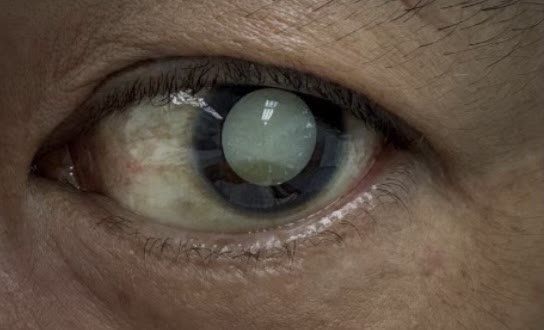
Cataract
The lens clouds and yellows, scattering light. Everything looks dimmer and duller, and lights at night grow haloes and glare. New glasses help less and less.
An educational simulation, not an eye test. Suitability for any treatment, and its likely result, can only be judged after a full assessment.
Who gets cataracts
Most cataracts are related to age, and many people over 60 have some clouding of the lens. They can also appear earlier:
- Age-related — the most common type.
- With diabetes — particularly when blood sugar has been high for a long time.
- After steroid medicines — long-term use of corticosteroid tablets, drops or inhalers.
- After an eye injury — sometimes years later.
- From birth or early childhood (congenital) — this needs prompt assessment, because vision is still developing.
Symptoms to look out for
Cataracts usually develop slowly and without pain, so changes can go unnoticed for a while. Common symptoms include:
- Cloudy, blurred or dim vision — like looking through a frosted window
- More difficulty seeing at night
- Glare and sensitivity to light, especially from oncoming headlights
- Haloes around lights
- Frequent changes in your glasses prescription
- Colours that look faded or yellowed
- Double vision in one eye
Not typical of cataract: a painful red eye, or vision that drops suddenly. These need prompt review — in an emergency, call 999 or go to the nearest emergency department.
How it is diagnosed
A cataract is diagnosed at a full eye examination: a vision test, a close look at the lens with a slit lamp, and an examination of the retina, usually after drops that widen the pupil.
If surgery is being considered, the eye is measured (biometry) to calculate the power of the lens implant, and other conditions that affect vision are looked for, so that expectations are realistic.
When surgery is considered
There is no need to wait for a cataract to become “ripe”. Surgery is usually considered when the cataract begins to affect things that matter to you — driving, reading, work or hobbies — or when it makes another eye condition harder to examine or treat.
Early on, updated glasses and brighter lighting may be enough. The decision is yours, made together after the examination.
Cataract surgery (phacoemulsification)
Through a small incision, an ultrasound probe breaks the cloudy lens into tiny pieces, which are gently removed. A clear artificial lens — an intraocular lens, or IOL — is placed in its position.
- It often takes around 15–20 minutes per eye.
- It is done under local anaesthetic, usually numbing drops, so a general anaesthetic is not normally needed.
- It is a day procedure: most people go home the same day.
- The two eyes are usually treated on separate days.
- Eye drops are used for a few weeks afterwards, and the team explains what to avoid while the eye heals. Recovery varies from person to person.
Like any operation, cataract surgery carries risks. They are explained to you, for your eyes, before you decide.
Choosing the lens that replaces yours
Lens implants differ in how they share focus between distances:
- Monofocal — clear at one distance, usually far; reading glasses are often still needed.
- Extended depth of focus (EDOF) — a longer range from far to arm’s length, with mild trade-offs at near.
- Multifocal — far, intermediate and near; some people notice haloes around lights at night.
- Toric — corrects astigmatism at the same time, available in the designs above.
The right lens depends on your eyes, your work and the trade-offs you are comfortable with. It is chosen together, after measurements. Compare them below.
Monofocal lens
Sharp at one distance, usually far. Most people use reading glasses for close work, and often for the computer. Night-time haloes are uncommon with this design.
An illustration only. Which lens suits you depends on measurements of your eye, any other eye conditions, your work and hobbies, and the trade-offs you are comfortable with. It is decided together, after assessment.
Common questions
How do I know if I need cataract surgery?
When the cataract begins to interfere with daily activities such as driving, reading or watching television. There is no need to wait until it is “ripe”. The decision is made together, after an examination.
What are the risks of cataract surgery?
Cataract surgery is one of the most commonly performed operations. As with any surgery there are risks — for example infection, inflammation, raised eye pressure, or a later clouding of the membrane behind the lens implant, which can usually be treated with a laser. Your own risks are discussed before you decide.
Will I still need glasses afterwards?
That depends mainly on the lens chosen and on your eyes. With a monofocal lens most people use reading glasses. Extended-depth-of-focus and multifocal lenses aim to reduce the need for glasses, with trade-offs that are discussed after measurements.
Can both eyes be done at the same time?
Usually the eyes are treated on separate days, so that the first eye can settle and be checked before the second is done.
This page is general education about cataracts and does not replace an individual consultation. Suitability for any treatment, and its likely result, can only be judged after a full assessment.
Content reviewed by Dr Helen Tan, Senior Consultant Ophthalmologist and Refractive Surgeon, MMC 38094.